
14.9.2026
7
mins
By
Ben Gleisner
Quick answer: If your gas hot water is working, nobody is telling you to rip it out this weekend. But the case for planning the switch got firmer this month. Methanex, which uses 40% of New Zealand's gas, has told the market it will idle its plant in early 2027 because domestic gas is declining with no clear path to new supply, and the industry's own view is that households should not expect gas to get cheaper as a result. Meanwhile a hot water heat pump uses about a third of the energy of gas water heating and costs about $180 a year to run against $480 for a standard electric cylinder. The sensible move for most households is to decide now what you will fit when the current system dies, rather than in a panic on the day it does.
What just changed with gas?
On 1 September, Methanex announced it had sold substantially all of its New Zealand natural gas contractual entitlements and would "indefinitely idle" its New Zealand production facilities during the first quarter of 2027. Its reason, in its own words, was "the continued decline in domestic natural gas availability and the lack of a clear pathway to meaningful new supply".
That matters to households for a reason that is not obvious. Methanex uses 40% of the country's gas, so the instinct is that its exit frees up supply and prices fall.
The people who run the pipes disagree. Ben Gerritsen, general manager of customer and regulation at Clarus, put it plainly to RNZ: "The costs of the pipeline network and delivering gas throughout the North Island are essentially fixed. They're the infrastructure costs of transporting the gas."
In other words, the network costs the same to run whether a lot of gas or a little flows through it, and those fixed costs get spread across the households still connected. Freed-up supply may ease things for industrial buyers. It does not follow through to your bill.
None of that is a prediction about what gas will cost in five years, and anyone who tells you they know is guessing. The honest framing is narrower: the supply picture is tightening, the cost structure does not favour households, and that is a reasonable thing to weigh when you choose what to install next.
So what actually is a hot water heat pump?
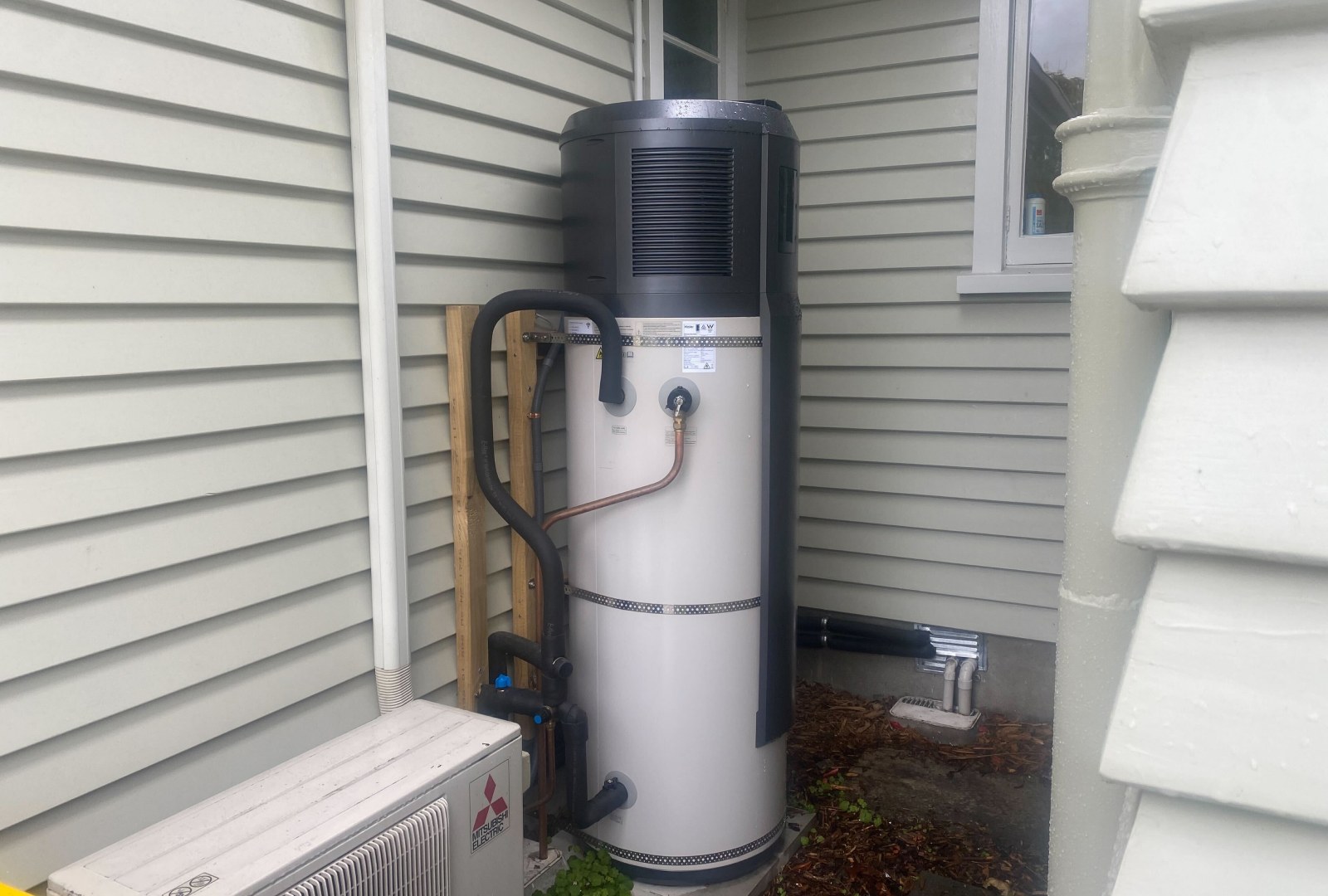
It is the appliance that replaces your hot water cylinder. It heats water by moving heat out of the air rather than by running an electric element or burning gas.
It is a different machine from the heat pump on your living room wall, which heats air. Both are called heat pumps, which causes more confusion than anything else in home electrification. We have written about that separately.
The efficiency comes from moving heat rather than making it. EECA puts a hot water heat pump at around a third of the energy needed by an electric resistance cylinder or by gas water heating, and 60 to 75% less electricity than a conventional electric hot water system.
The two types, which is the whole choice
Once you have decided on a hot water heat pump, there is really only one decision to make, and it is about where the parts go.
Integrated, or all-in-one. The heat pump and the cylinder are a single unit, and it has to be installed outside. EECA's note is that this "can be easier to install, depending on your home's layout and plumbing". It is the simpler option when you have a sensible spot outside and no strong reason to put the cylinder anywhere in particular.
Split system. Two separate parts: an outdoor unit, and a cylinder that can go inside or outside. EECA says this "offers more flexibility and can sometimes be retrofitted into your existing hot water cylinder". The flexibility is the point. If your cylinder currently sits in a cupboard near the bathroom, a split system can keep it there, which means shorter pipe runs and less waiting at the tap.
Either way, the heat pump part goes outside. That is not optional, because it needs air to pull heat from.
The retrofit option is worth asking about. If your existing cylinder is in good condition, a heat pump can sometimes be added to it rather than replacing the whole thing. Whether that is available to you depends on the cylinder, so it is a question for the installer rather than something you can work out from the driveway.
What does it cost, and what does it save?
EECA's figures, which are the ones worth using because nobody is selling you anything:
- A new traditional electric cylinder: about $4,000 to buy and install. A new gas system costs about the same, roughly $4,000.
- A hot water heat pump: about $7,000.
So it is around $3,000 more upfront. Then the running costs go the other way:
- A standard electric cylinder: about $480 a year.
- A hot water heat pump: about $180 a year.
That is roughly $300 a year back, which pays down the difference over about a decade on the electric comparison alone, and every year after that is money you keep. If you are replacing an old cylinder that was going to cost you $4,000 anyway, the real decision is about the $3,000 gap, not the $7,000 sticker.
On emissions, EECA has a standard electric cylinder producing around 3.5 times the carbon of a hot water heat pump, and a gas system around 7 times.
Should you rip out gas that still works?
No, and we would not suggest it.
Replacing a working appliance early rarely stacks up, and hot water systems often have years left in them. What changes with the gas news is not the urgency, it is the default.
The useful move is to decide now what goes in when the current system fails, because that decision otherwise gets made at 6am on a Sunday with whatever the plumber has on the van. Hot water systems do not fail politely. A household that has already decided "heat pump, split system, cylinder stays in the cupboard" makes a good decision under pressure. A household that has not decided gets a like-for-like swap and another fifteen years of the same bills.
Two other things worth knowing while you are deciding. If you are on bottled LPG rather than piped gas, the running-cost gap is wider still. And if your gas connection exists mostly for hot water, at some point the fixed daily charge for the connection is worth more scrutiny than the gas you actually burn.
Frequently asked questions
Is a hot water heat pump the same as the heat pump on my wall?
No. The wall unit heats air. A hot water heat pump heats water and replaces your cylinder. Having one does not mean you have the other.
Integrated or split, which should I choose?
Integrated is one unit outside and can be simpler to install. A split system separates the outdoor unit from the cylinder, so the cylinder can stay inside near your taps. Split also opens up the possibility of retrofitting to your existing cylinder.
How much does a hot water heat pump cost in New Zealand?
About $7,000 to buy and install, against about $4,000 for a traditional electric cylinder or a new gas system. Running costs are about $180 a year versus about $480 for the cylinder.
Will gas get cheaper now that Methanex is leaving?
The industry view is no, at least not for households. The pipeline network's costs are essentially fixed regardless of how much gas flows through it.
Should I replace my gas hot water right now?
Not if it is working well. Decide what you will fit when it fails, so the decision is not made for you in an emergency.
Run your own numbers
What suits your house depends on where your cylinder sits, what you are heating with now and how much hot water you get through. The Cogo platform runs those numbers for your household, then points you at vetted installers if you want a quote.
See what switching your hot water would save
This article is general information only. It is not financial, energy or product advice. What you save depends on your home, your power plan and how you use energy, so get quotes from qualified installers or licensed dealers and seek independent advice for your own situation.
Read More
.png)

Subscribe to our newsletter to keep up to date with the latest news and articles about carbon management.
